


How to better protect consumer rights in times of digital revolution?
Personal data protection and consumer protection on the Internet increasingly concern the same event, e.g. profiling or dark patterns. What is the position of the President of the Personal Data Protection Office in this consumer protection ecosystem? – ‘Formally, these are separate legal regimes and separate competences of authorities, but in the digital economy they increasingly form a single ecosystem of human protection’, Konrad Komornicki, Deputy President of the Personal Data Protection Office, explained during the Digital Economy Forum.
This year, the Forum, organised by the Chamber of Electronic Economy, brought together the perspectives of business, consumers, public administration and digital market experts, focusing on trust as one of the most important elements in the development of the digital economy.
They discussed how to effectively protect consumer rights in the era of the digital revolution. How does the development of e-commerce affect the security, convenience and trust of customers or, finally, how to ensure the security of transactions, personal data and sensitive data?
There was no shortage of issues related to the issue of reconciling technological innovation with privacy, transparency of algorithms, ethics and law.
One thing, many rights
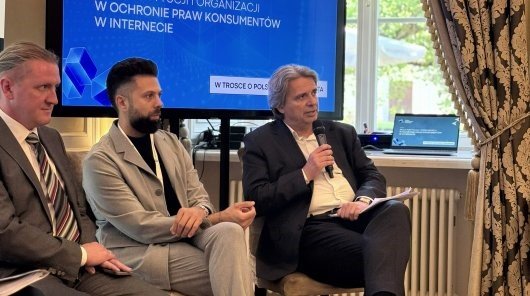
Konrad Komornicki, Deputy President of the Personal Data Protection Office, took part in the panel ‘Role of institutions and organisations in the protection of consumer rights on the Internet’. The discussion was moderated by Witold Chomiczewski, representative of the Management Board of the e-Chamber for legislative matters. And together with a representative of the Personal Data Protection Office, the contributions to the discussion were made by:
· Patrycja Sass-Staniszewska, President of the Chamber of Electronic Economy
· Marianna Sidoroff, Director of the Digital Economy Department at the Ministry of Development and Technology
· Grzegorz Miś, District Consumer Ombudsman in Wrocław and expert of the Aquila Consumer Protection Association
· Tomasz Osman, President of the Management Board of SAVICKI
Personal data protection and consumer protection are formally two different legal regimes, but on the Internet they increasingly concern the same event, e.g. profiling or dark patterns.
‘Formally, these are separate legal regimes and separate competences of authorities, but in the digital economy, they increasingly form a single ecosystem of human protection. The President of the Personal Data Protection Office is not a consumer protection authority, just as the President of the Office for Competition and Consumer Protection is not a supervisory authority within the meaning of the GDPR. On the other hand, the person using the online platform is, at the same time, a user, a consumer and a data subject. For this individual, the roles are not separated. Therefore, the same action by the entrepreneur may at the same time affect the ability to freely make a purchase decision and the ability to actually decide on his personal data’, Konrad Komornicki explained during the panel.
‘In March this year, during the EDPB conference on cooperation between regulators, the thesis that the digital economy does not work in silos was very strong. The same matters may be subject to data protection law, consumer law, competition law and digital platform regulation. Dark patterns are a very good example. We can have an interface that deliberately makes it difficult to refuse consent, exposes the button I accept, hides an alternative or, through the way the information is presented, induces a person to make a decision that he would not have made otherwise. From the point of view of consumer protection, we then ask about the manipulation of the market decision and the fairness of the trader's practice. From the perspective of the GDPR, however, we ask whether consent was indeed voluntary and informed, whether the principle of transparency was respected and whether the design of the interface allowed a person to actually exercise his or her rights’, added the Deputy President of the Personal Data Protection Office.
Something for the citizen and something for the entrepreneur
During the discussion, Konrad Komornicki was also asked about the new body, which is the Committee on the Development and Safety of Artificial Intelligence and how cooperation between the Personal Data Protection Office and the new Committee should be built?
‘I am very much looking forward to working out principles of cooperation with the new AI regulator similar to those that have been worked out between the President of the Personal Data Protection Office and the President of the Office for Competition and Consumer Protection. This cooperation did not start yesterday. The Personal Data Protection Office cooperates with the Office for Competition and Consumer Protection and the Office of Electronic Communications through working groups in which the strongest competences of individual offices can be used. Such a model is reasonable: the authority that first identifies the problem should know who to turn to and how to quickly start cooperation, instead of expecting the citizen to understand the complicated map of regulators' competences’, emphasised Konrad Komornicki. In the next part, he also talked about the benefits that such cooperation will bring to entrepreneurs. Good cooperation between regulators means greater legal predictability, less risk of receiving conflicting signals, the ability to identify problems earlier and more uniform guidelines. It can also reduce unnecessary duplication of administrative activities, of course without restricting the independent competences of individual authorities. The exchange of information and joint action are intended not only to improve the effectiveness of the protection of individuals, but also to provide the industry with greater transparency and regulatory certainty.
The Digital Economy Forum "For the sake of the Polish consumer" was organised by the Chamber of Electronic Economy on 16 September in Warsaw, at the Bellotto Hotel.