



President of the Personal Data Protection Office presented the 2024 Annual Report
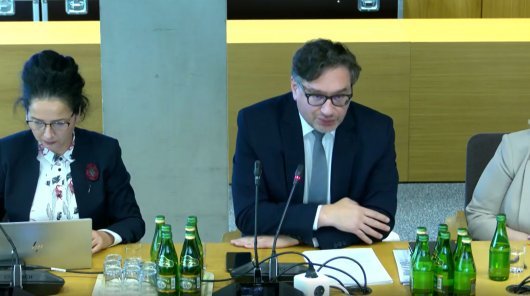
On 15 October 2025, Mirosław Wróblewski, President of the Personal Data Protection Office, appeared before the Justice and Human Rights Committee of the Polish Parliament to present the Annual Report on the activities of the Office in 2024. This annual report fulfils the obligation under Article 59 of Regulation (EU) 2016/679 (GDPR) and Article 50 of the Polish Act on the Protection of Personal Data of 10 May 2018. The Committee adopted the report.
Scope of activities and priorities of the office
The President outlined the functioning of the Office, ongoing proceedings, and the most important actions taken in 2024. Members of the Committee were informed about the supervisory authority’s tasks, including monitoring and enforcing compliance with GDPR, handling complaints and breaches, and issuing opinions on draft legislation. A significant part of the Office’s work also involves educational initiatives and efforts to raise public awareness of data protection, which contribute to the security and resilience of the State, particularly in the digital sphere.
Complaints and administrative decisions
In 2024, the Office received 8,056 complaints – over a thousand more than in the previous year. This increase reflects effective information and educational campaigns and growing public awareness. The number of complaints concerning new technologies rose significantly.
Last year, the President of the Personal Data Protection Office issued 1,719 administrative decisions. Pursuant to Article 58(2) of the GDPR, 27 administrative fines totalling PLN 13,907,740.96 were imposed in 22 cases (in 2023 – 31 fines totalling PLN 1,230,331.28).
The authority received 14,842 reports of personal data breaches. Inspections were carried out in 50 entities, mainly as part of the sectoral inspection plan.
Opinions on legal acts and legislative cooperation
In 2024, the Personal Data Protection Office issued opinions on 779 draft legal acts. President Wróblewski emphasised that the Office plays an expert role in the legislative process and actively participates in the work of the Digitalisation Committee coordinated by the Minister of Digital Affairs.
The President of the Personal Data Protection Office also signed cooperation agreements with the Government Legislation Centre and the Polish Legislation Society, which aim to improve the quality of legislative techniques and take data protection aspects into account at the earliest possible stage of the legislative process.
Court proceedings and legal advice
In 2024, there was a decrease in the number of complaints against decisions of the President of the Personal Data Protection Office submitted to the Voivodeship Administrative Court – 168 compared to 223 in 2023.
Data controllers and natural persons submitted 2,214 legal questions to the office.
The President of the Personal Data Protection Office issued 14 statements to administrative bodies and the private sector and filed a report on the possibility of a crime being committed in connection with the leakage of personal data from the Chinese sales platform Pandabuy.
International cooperation and educational activities
The Polish supervisory authority actively participated in the work of the European Data Protection Board (EDPB) and analysed the impact of 27 CJEU judgments on the Polish legal system.
The President of the Personal Data Protection Office also summarised the extensive educational and information activities carried out by the Office. In 2024, numerous cooperation agreements were signed with organisations and foundations, including the Ombudsman for Children and the Polish Federation of Third Age University Associations. Together with the Orange Foundation, a guide entitled ‘The image of a child on the internet. To publish or not to publish?’ was developed to support parents and guardians in the responsible use of the internet.
Challenges and new competences
President Mirosław Wróblewski emphasised that technological development – especially in the field of artificial intelligence – poses new challenges for privacy, particularly with regard to children, young people and senior citizens. He also drew attention to the need for ongoing educational activities on the safe use of digital technologies.
In conclusion, he emphasised the importance of preparing the office to perform new competences resulting from the implementation of a package of EU digital regulations into the Polish legal system, such as: the Data Governance Act (DGA), the Artificial Intelligence Act (AI Act), the European Health Data Space (EHDS), Digital Services Act (DSA) and other acts under the European Data Strategy.